Imagine that there exists a system capable of predicting market direction with a probability exceeding 90%.
And imagine that this claim is supported by fully transparent, verified statistical data.
For now, we are not even talking about our AI (we will come back to it shortly).
We are referring to a hypothetical system that, over tens of thousands of trades, demonstrates a win rate above 90% — or even above 95% — in a consistent and verifiable manner.
It is important to highlight the following.
When we asked systems like GPT and Grok whether such systems exist, they were unable to recall any examples within their extensive knowledge bases.
The question was simple:
Does there exist any system that, across tens of thousands of trades, on multiple currency pairs (for example 15–20), at different times and directions chosen by the system itself, achieves a win rate above 90–95% in predicting market direction — bullish or bearish?
The answer was essentially the following:
There is no convincing public evidence of such a system. Claims of a 90–95% win rate across large datasets, multiple instruments, and varying conditions are considered highly unlikely under real market conditions.
Fair enough.
Now let’s look at our own data.
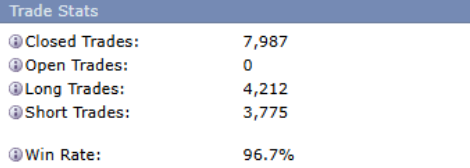
We examine tens of thousands of trades — and note that on verified and publicly tracked accounts alone, there are already more than 13,000 trades since publication began — and we observe a win rate of approximately 95%.
Let’s make a key clarification.
This is not about marketing (we have no interest in that), and certainly not about making claims like “look how impressive this is.” That is not the point.
On one hand, our AI has produced these results. On the other hand, such results are not something commonly observed elsewhere.
The real question is different:
How should such a system be understood?
How do we interpret its logic using conventional approaches (for example, traditional technical analysis), which were never designed to evaluate systems operating with a 95% win rate?
We will say this directly: we do not expect everything in such a system to be obvious or fully explainable.
What it detects, how it forms its conclusions, and how those conclusions are reflected in verified statistics — all of this may remain only partially interpretable to us.
This may sound bold, but in practice it appears that we have entered relatively unexplored territory.
Something genuinely new — and something worth studying further.
At the same time, it is important to emphasize:
A high win rate does not automatically imply profitability.
Correctly identifying market direction is not the same as making money.
It is entirely possible to be right multiple times in a row — even many times — and then lose everything on a single poorly controlled trade.
We have no illusions about this.
However, we are not discussing isolated sequences of 10 or even 100 trades.
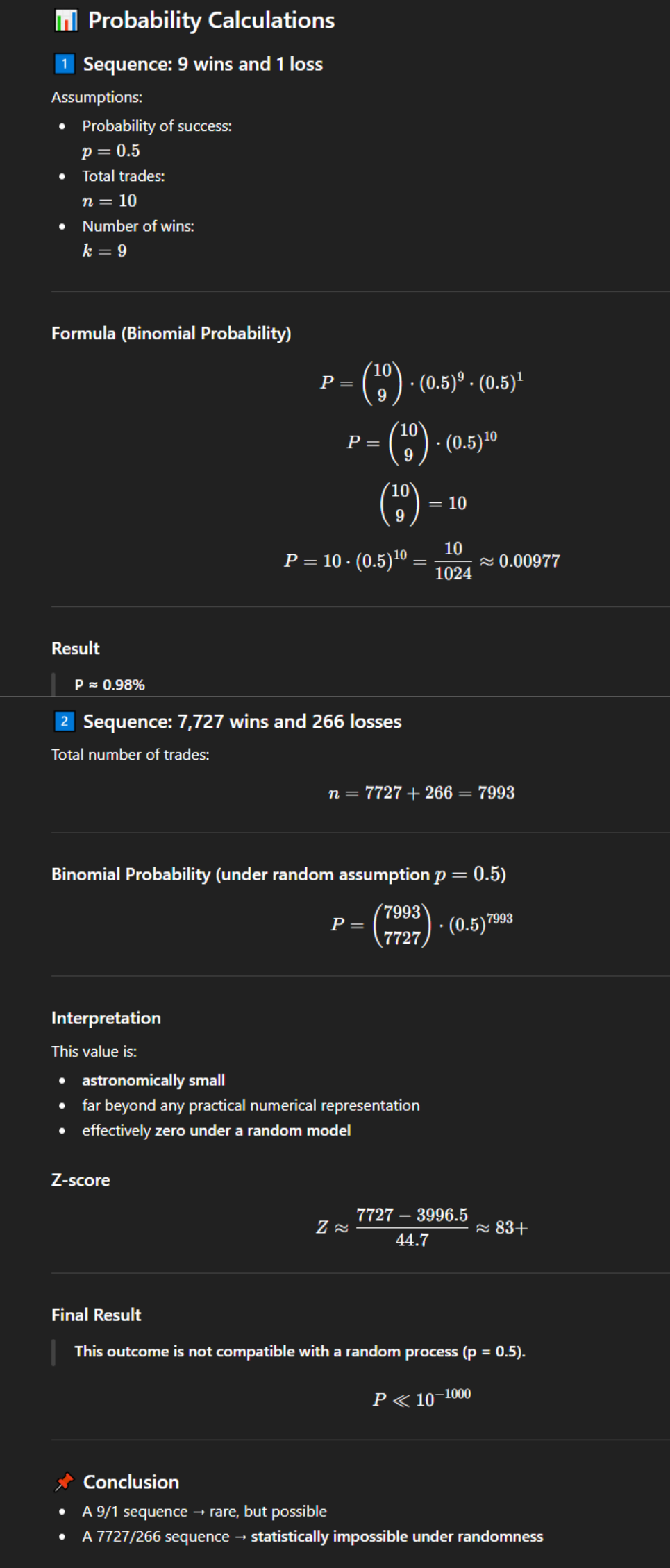
Let us briefly turn to mathematics — specifically, the binomial distribution.
The baseline probability in the market can be approximated as 50/50 (p = 0.5).
We can calculate the probability of a sequence of 9 successful trades and 1 unsuccessful trade.
We can also calculate the probability of observing a sequence such as:
7,727 winning trades and 266 losing trades
These are real figures taken from one of our accounts.
The calculations were performed using AI tools so that anyone can reproduce them independently (see the attached screenshot).
Conclusion:
• A 9/1 sequence → rare, but possible
• A 7727/266 sequence → statistically impossible under randomness
So what does this mean?
First and most importantly: the AI’s decisions are clearly not random.
At a 1% probability level, randomness could still be considered. But when probabilities become astronomically small, the explanation of “random outcomes” is no longer valid.
If we avoid absolute statements such as “the AI understands the market,” and instead use a more careful and precise interpretation, we arrive at the following:
We are dealing with a system capable of reliably extracting information about market structure across different regimes.
It demonstrates statistical predictability and, most importantly, a consistent ability to extract an edge.
This is exactly what we will explore further in our next publication.