“Madness is rare in individuals — but in groups, parties, nations, and epochs, it is the rule.”
Friedrich Nietzsche
A small departure from the usual format — a bit of reflection 😉
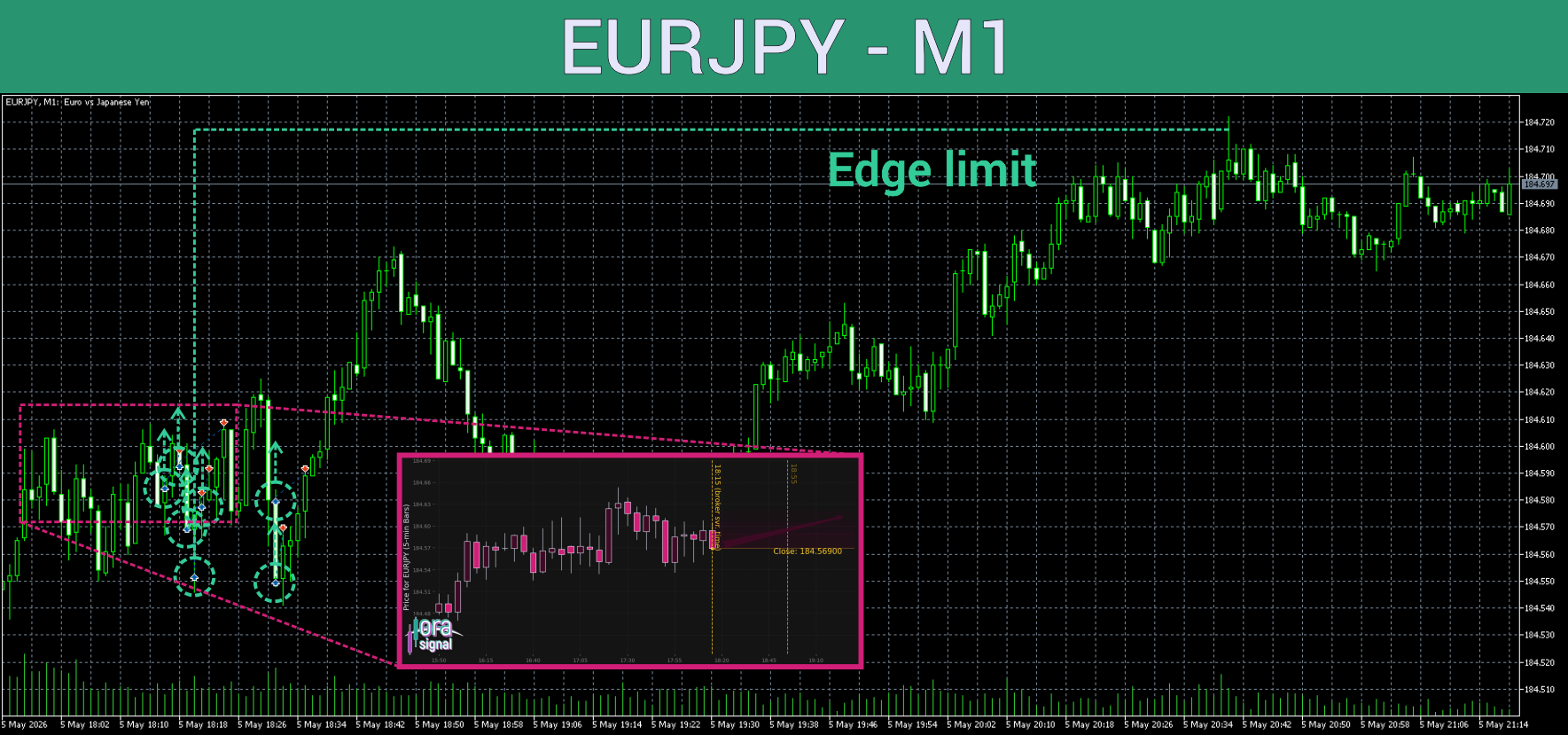
What is especially telling — we do not use traditional technical analysis when presenting ORA AI trades.
Here is the trade. Here is the chart. Here is the result.
And also — overall limits and edge buffer.
Simple, right? 🙂
And yet, this simplicity often вызывает resistance.
Because many traders are used to thinking that things must be “MUCH more complex.”
How can one trade without geometric constructions? 😏
Let me say something as an engineer with a strong mathematical background — and I’ll try not to offend anyone…
The idea that geometric lines, shapes, and patterns — because they come from mathematics — must therefore inherently “work”…
That by drawing complex constructions, one somehow gets closer to results…
This is not how it works.
Patterns in technical analysis are equivalent only to other patterns in technical analysis (a fundamental law of logic).
A pattern is just a pattern.
A result is a result.
And whether one leads to the other — must be proven.
A pattern does not equal a result by default.
Without verification, the idea that “a complex pattern drawn over hours = result” is just speculation — at best a hypothesis, not an equation.
What matters is not the pattern.
What matters is the outcome of actions.
Your conclusion.
Why are you drawing these structures?
For the illusion of meaningful work — or for an actual result?
Our AI trade visuals show only one thing — results.
Trade timestamp (publicly фиксирован in Telegram and ForexFactory) → result.
Manipulation or “adjustment” of data? Irrelevant.
Because falsified data leads only to false conclusions.
Real performance is real.
Fake performance is fake.
The Key Question
If what you are doing does NOT work — it raises a serious question:
- What is the value of your time?
- What is the value of your effort?
Either something works — or at the very least, it must be tested for real usefulness.
The most dangerous thing is the illusion of importance.
The illusion.
“I am drawing, analyzing, building — therefore it must be meaningful.”
But the only thing that truly matters is the result.
“I Don’t Understand It — So I Don’t Trust It”
We often hear (or feel from reactions):
“I don’t understand how this works, so I don’t trust it.”
Pause.
What does “works” actually mean?
“Works” = result.
And yet, this statement implies something deeper:
“I don’t understand this — but I understand something else better.”
Do you?
A Simple Test
Take a classic pattern — for example, “Head and Shoulders.”
Follow the rules. Enter trades correctly.
Then measure results:
- 10 trades
- 20 trades
- 100 trades (minimum)
Suppose:
- 60 wins / 40 losses → 60% win rate
- Or worse: 30 wins / 70 losses → below random
Key question:
Does it actually work?
Or were you just repeating something without statistical validation?
What Research Shows
We live in the 21st century. This has already been studied.
Hundreds of studies show:
- Most patterns deliver ~50–55% probability
- Sometimes ~60%
- Rarely ~70%
In other words:
They barely outperform randomness.
The Coin Analogy
Flip a coin 10 times.
You will often get:
- 7/3
- 8/2
Does that mean the coin has an edge?
No.
Randomness can produce the same short-term results.
Only large samples reveal the truth.
And reaching those samples costs:
- money
- time
- and often — losses
Our Approach
We take a different path.
Not single events — but thousands of them.
Public data shows:
- >10,000 trades
- >95% win rate
Core idea:
What worked thousands of times is far more likely to work again.
Because:
- pattern = one event
- system = thousands of events
Key distinction:
- pattern ≠ proof
- statistics → proof
This is why large-scale statistical systems consistently outperform classical TA.
Final Thought
Ask yourself honestly:
You’ve read about TA.
You know how many conditions must align.
So why do so many still believe it magically guarantees outcomes?
It doesn’t.
It cannot exceed its statistical probability.
And that has already been demonstrated countless times.
We are not attacking TA.
We simply state:
TA performs at its inherent probability level.
ORA performs — see the public data.
And remember:
“A thousand people can believe something — and still be completely wrong.”
Or, as Bertrand Russell said:
“The fact that an opinion has been widely held is no evidence whatever that it is not utterly absurd.”

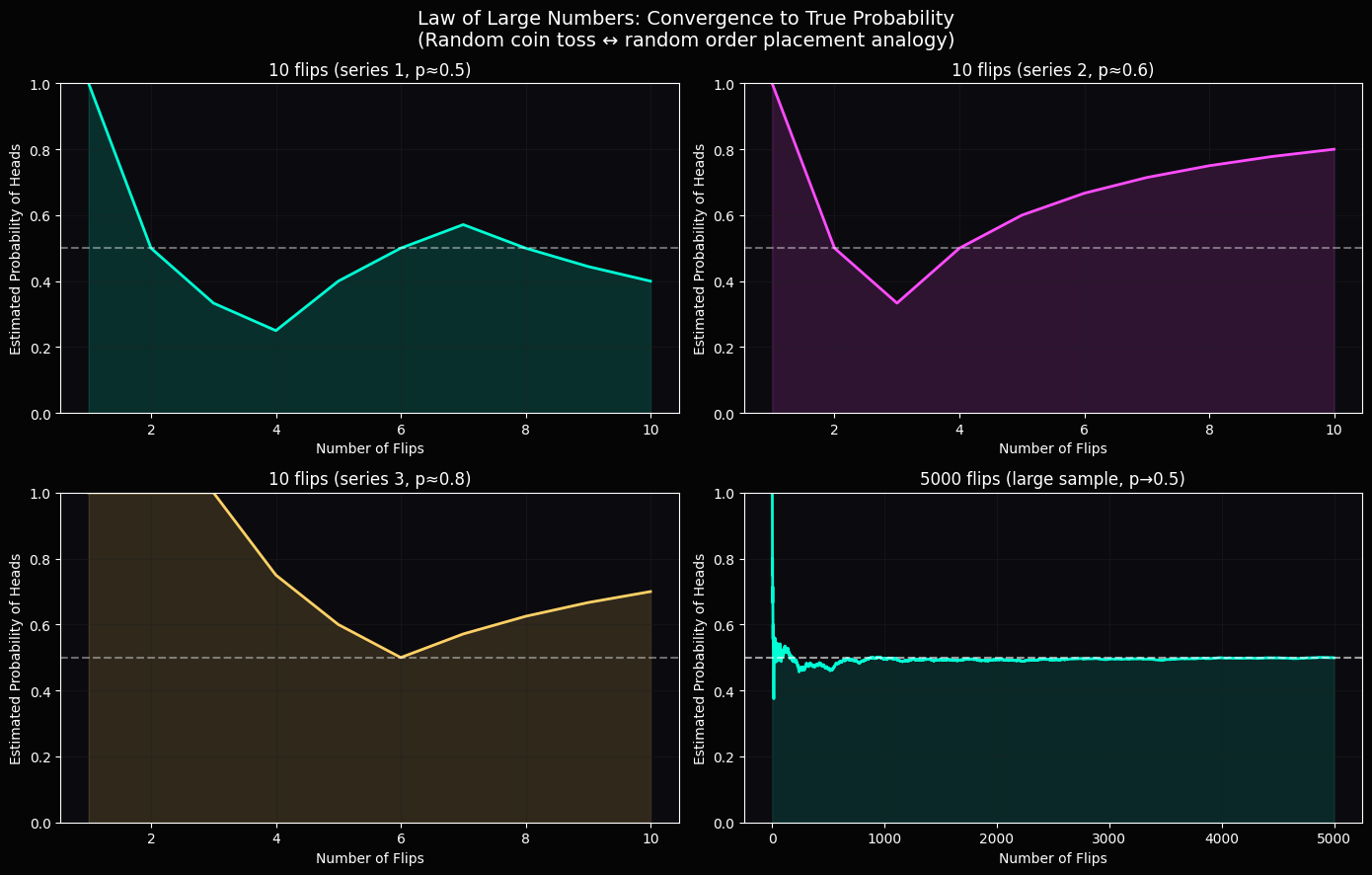
In small samples, observed outcomes can deviate significantly from the true probability, sometimes creating a misleading impression of the underlying process.
Only through a large number of repeated events (e.g., order placements) does the observed frequency converge to the true probability.
In other words, the more trials you have, the more accurately your results reflect your actual predictive ability.