

"I don’t look to jump over 7-foot bars. I look around for 1-foot bars that I can step over."
Warren Buffett
The main goal of our blog is to introduce traders to our system and our approach to market analysis.
At first glance, everything should be fairly straightforward:
- there are results,
- statistics,
- verifiable metrics,
- and public accounts.
In other words, there are objective indicators that should at least deserve attention.
However, something else regularly surprises us. We constantly observe how aggressive marketing from various “strategy creators” and “success sellers” often becomes far more visible than real, verifiable systems.
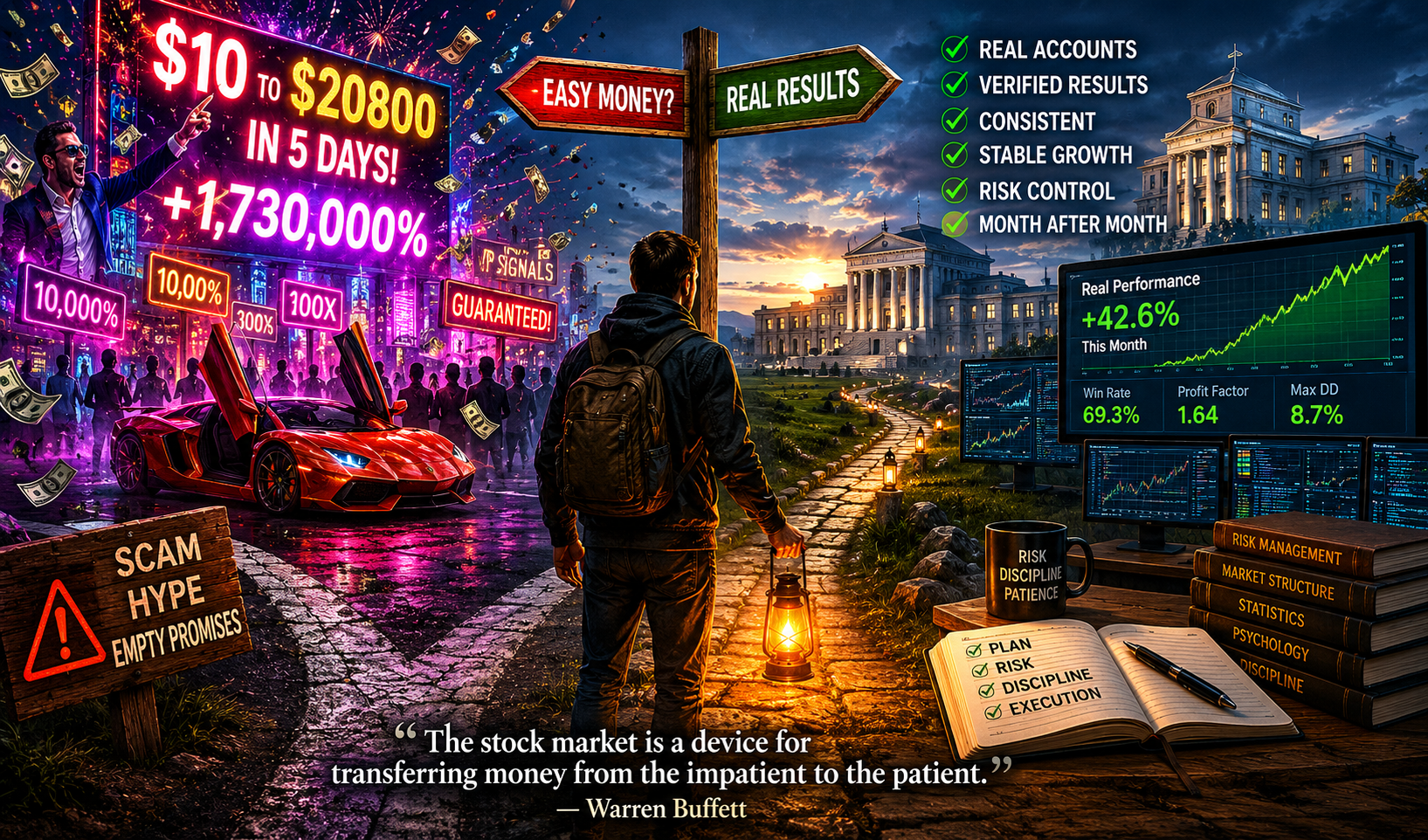
All it takes is opening almost any trading-related advertising feed. Right before writing this article, we came across the following headline: “$10 to $20,800 in 5 days”. And statements like this have practically become normal.
But the main issue is not the advertisement itself. The real question is: why is it that in trading — a field supposedly connected to mathematics, probabilities, logic, and risk — there is so much unrealistic nonsense and outright deception?
Sometimes it feels as though the less believable the claim is, the more attention it receives. Meanwhile, genuinely strong and statistically sound systems can appear “too boring” in comparison.
Because:
- +40% monthly returns with verified statistics sounds far less emotional than:
- “10,000% in a week”.
A Little Common Sense
Let us imagine a medium or large hedge fund. Typically, such organizations consist of teams of analysts, quantitative researchers, risk managers, macro specialists, advanced infrastructure, and millions or even billions under management.
Many professionals come from institutions such as Harvard, Oxford, MIT, Stanford, and other top universities.
Now let us ask a simple question: What kind of returns do these organizations actually generate?
If we examine real institutional reports, the picture usually looks like this:
- ~10–15% yearly returns — considered good,
- ~20% — a very strong year,
- ~30% — rare exceptional performance.
And these numbers are already viewed as highly professional results.
Now Compare This to “Miracle Returns”
Open signal rankings, trading advertisements, MQL5, Telegram channels, or various “VIP systems”. Suddenly we see:
- 300%
- 10,000%
- 1,730,000%
- “$10 → $20,800 in 5 days”
At this point, a logical question naturally appears. If such results are truly stable and realistic, then why do quantitative funds exist? Why do universities teach finance? Why is risk management necessary? Why does institutional research even exist?
Why are the largest funds in the world not producing 10,000% weekly returns, 1,000x gains, or millions of percent?
Where the Problem Actually Is
It is important to understand: showing massive returns on an isolated account is technically not that difficult. For example, one could theoretically open multiple accounts, use extreme leverage, aggressively increase position sizes, and eventually produce a “spectacular” short-term result.
But this is not a strategy. Because the real question is not “Can someone occasionally generate extreme returns?” The real question is: “Can this be done consistently, long-term, and with controlled risk?”
This is exactly where most “miracle systems” disappear. Because one delayed position, one strong impulse, or one unfavorable market sequence can require enormous capital simply to survive.
This is why extreme short-term returns are very often excessive risk, randomness, or pure marketing.
Our Approach
We do not use this kind of marketing. That is precisely why we are impressed by our AI system. Not because of “millions of percent”. But because of stability, statistics, repeatability, and public verifiability.
If a system demonstrates 40–50% monthly returns on real accounts, with real history and continuously published statistics, then that already deserves serious attention. Especially in an industry where most loud promises disappear after weeks or months.
Final Thought
Stop evaluating trading based on flashy screenshots and gigantic percentages. Markets are far more complex than marketing. And extreme returns without realistic explanations of risk usually say much more about overconfidence, manipulation, or misunderstanding of risk than about genuine skill.
In trading, what truly matters is not isolated “miracles”. What matters is consistency, statistics, transparency, and the ability of a system to survive over long periods of time.